
Music reliably changes mood by engaging your brain’s reward systems and shifting your body’s arousal state, often within seconds of pressing play. This isn’t a feel-good claim. It’s one of the most replicated findings in behavioral neuroscience, and understanding it gives you a real, practical tool for managing stress, energy, and emotional well-being every single day.
Here’s the short version of what the research shows:
-
Mood regulation is the single most common reason people report listening to music across cultures and contexts.
-
Measurable changes in heart rate, skin conductance, and subjective mood can appear within seconds to minutes of listening.
-
Survey data from the COVID-19 pandemic found more than half of respondents used music as a coping strategy for stress and mood regulation.
-
Clinically meaningful mood improvements have been documented after repeated daily listening over several weeks in post-stroke recovery studies.
The science here is deep, and the practical applications are real. At Pttmusic, we’ve built an entire catalog around this idea: that music should do more than fill the silence. It should move you somewhere better.
Table of Contents
-
Which emotions does music reliably evoke, and what drives them?
-
What is music therapy, and when should you see a credentialed practitioner?
-
How to use music to shift your mood: the Iso Principle and practical routines
How does music affect mood in the brain and body?
The short answer is that music works through multiple overlapping biological pathways at once, which is part of why its emotional effects feel so immediate and so hard to ignore.
Reward circuitry and dopamine
When you hear a song you love, your brain’s reward circuitry activates. The nucleus accumbens and ventral striatum, the same regions that respond to food and social connection, release dopamine in anticipation of and during musical peaks. This is why a favorite song can produce that spine-tingling sensation researchers call “frisson.” The pleasure is real, neurochemical, and measurable.

Stress hormones and autonomic shifts
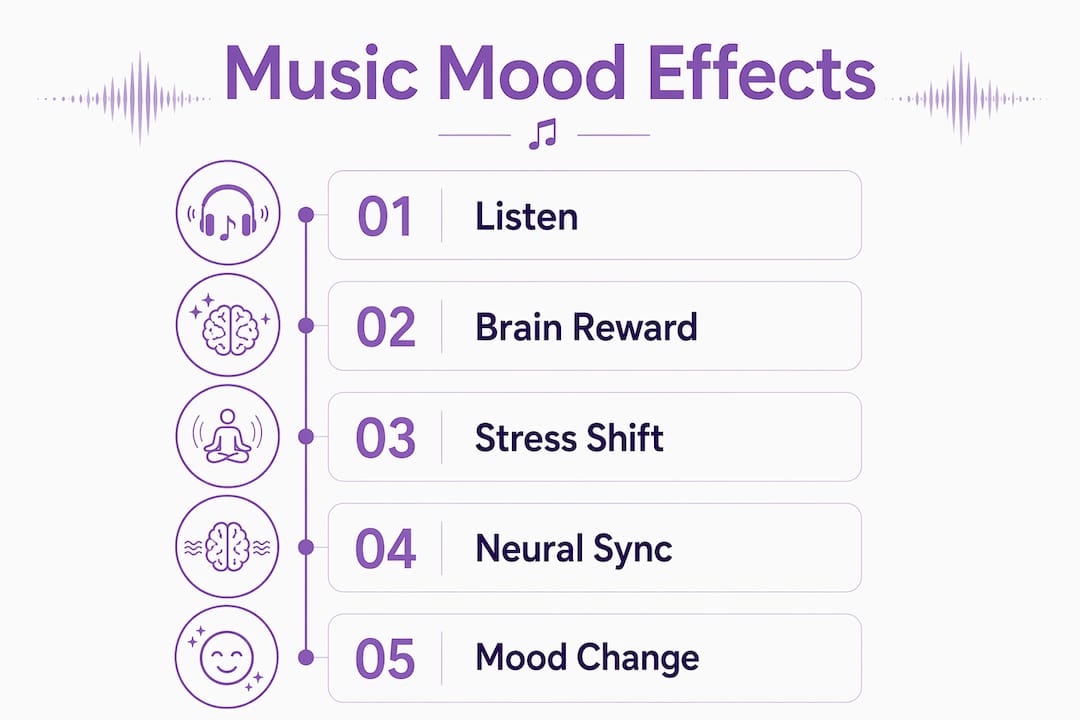
Music also reaches your body’s stress-response system. Arousing music increases heart rate and muscle tension, while calming music lowers both. Cortisol, the primary stress hormone, has been shown to decrease in response to slow, predictable music, particularly when the listener feels a sense of control over the selection. Blood pressure and respiration rate follow similar patterns, meaning a well-chosen track can nudge your entire autonomic nervous system toward calm or toward readiness.

Neural entrainment
Rhythm does something particularly powerful. Your brain’s timing systems synchronize to a steady beat through a process called neural entrainment. This rhythm-driven synchrony influences attention, motor readiness, and arousal. It’s why an up-tempo track makes you want to move, and why a slow, steady pulse can anchor a scattered mind. The Translational Psychiatry review identifies rhythm as one of four core biological principles linking music to mental health, alongside tonality, reward, and sociality.
The brain as a prediction machine
A 2026 paper in Frontiers in Psychology offers a compelling framework: music-evoked emotion as active interoceptive inference. The idea is that your brain doesn’t passively receive music. It actively constructs a “virtual” body state from musical cues, matching what it hears to predictions about how your body should feel. A track with a pulse resembling a calm resting heart rate signals safety. A track with swelling dynamics and rising pitch signals anticipation. Your felt emotion follows the prediction.
This framework has a practical implication: you can choose music whose sonic cues match the bodily feeling you want to generate, and your brain will do much of the emotional work for you.
Which emotions does music reliably evoke, and what drives them?
Musical features map to emotional responses with enough consistency to be useful, though not with perfect predictability. Individual history, cultural background, and personal memory all shape the final experience. The table below captures the most replicated tendencies.
| Musical Feature | Typical Emotional Effect | Why It Works |
|---|---|---|
| Fast tempo (120+ BPM), major key | Increased energy, positive valence, readiness | Entrainment raises arousal; major mode signals resolution |
| Slow tempo (60–80 BPM), major key | Calm, warmth, contentment | Matches resting heart rate; major mode avoids tension |
| Slow tempo, minor key | Introspection, nostalgia, melancholy | Unresolved harmonic tension; matches low-arousal states |
| Loud dynamics, distorted timbre | Excitement, aggression, power | High arousal cue; activates sympathetic nervous system |
| Soft dynamics, warm timbre | Safety, tenderness, relaxation | Low arousal cue; parasympathetic activation |
| Lyrics with personal resonance | Strong autobiographical emotion | Memory association amplifies the base musical effect |
| Unpredictable structure | Curiosity, tension, surprise | Violates prediction; triggers dopamine-reward anticipation |
The key caveat: these are statistical tendencies, not guarantees. A minor-key song that carries a powerful personal memory of joy will likely feel joyful, not sad. Cultural conditioning matters too. Scales and modes that signal sadness in Western music may carry entirely different associations in other traditions. Personalization, whether through your own listening history or a therapist’s preference survey, consistently improves outcomes over any generic mapping.
How does music influence memory, attention, and cognition?
Music and memory are linked through several overlapping mechanisms. Emotional salience makes memories stickier, and since music reliably generates emotion, it also strengthens the encoding and retrieval of associated experiences. Auditory pathways connected to the hippocampus, the brain’s memory hub, remain relatively preserved even in conditions like Alzheimer’s disease, which is why a familiar song can unlock autobiographical memories that verbal prompts cannot reach.
The practical applications split into two distinct areas:
-
Study and focus: The evidence here is genuinely mixed. Background music at moderate volume and low complexity can reduce distraction and sustain attention for repetitive tasks. Lyric-heavy or highly dynamic music tends to compete with language-based work, impairing reading comprehension and writing. Instrumental tracks in the 60–70 BPM range are the most commonly recommended for focused work, though individual preference matters more than any single rule.
-
Dementia and reminiscence therapy: This is where the clinical evidence is strongest. Daily music listening has been shown to lower self-reported depression and improve cognitive function three months post-stroke compared with standard care alone. In dementia care, familiar music from a person’s young adulthood reliably triggers autobiographical recall and reduces agitation, even in late-stage patients. The preserved auditory pathways in the brain make music one of the few tools that can reach people when language no longer can.
The honest summary: music is a powerful cognitive tool, but its effects are task-specific. Match the music to what you’re trying to do, and the results are real.
Can music reduce stress and relieve pain?
Yes, and the physiological pathway is well-documented. Calming music helps activate the parasympathetic nervous system, helping to slow heart rates, reducing respiration rate, and lowering blood pressure. Cortisol levels drop. Muscle tension eases. The brain’s prediction systems, primed by a steady, familiar rhythm, signal that the environment is safe. That signal cascades through the body.
In clinical settings, the evidence is consistent. Music played before and during medical procedures reduces self-reported anxiety and perceived pain scores. Patients who listen to music before surgery report lower pre-operative anxiety than those who receive standard care alone. In pain management, music appears to work partly by occupying attentional resources, leaving less cognitive bandwidth for pain processing, and partly through direct modulation of stress hormones.
Building a calming pre-event playlist:
-
Select tracks at 60–80 BPM with minimal dynamic variation.
-
Favor instrumental or lightly vocal arrangements; avoid lyrics that demand active processing.
-
Choose familiar music you already associate with calm or safety. Familiarity reduces prediction error and deepens the relaxation response.
-
Keep the playlist 20–30 minutes long. Start 15 minutes before the stressful event.
-
Lower the volume to a comfortable background level. Loud music, even if slow, can maintain arousal rather than reduce it.
The same logic applies to everyday stress. A 20-minute wind-down playlist after work, built around slow tempos and warm timbres, can meaningfully shift your physiological state before you walk through your front door.
What is music therapy, and when should you see a credentialed practitioner?
Music therapy is a clinical discipline, distinct from personal music listening, in which a board-certified therapist uses music-based interventions to address specific health goals. The American Music Therapy Association (AMTA) defines two primary modes:
-
Receptive music therapy: The client listens to live or recorded music selected by the therapist to address mood, pain, or cognitive goals.
-
Active music therapy: The client participates in singing, playing instruments, songwriting, or improvisation to build emotional expression, motor skills, or social connection.
Clinical evidence supports music therapy across several conditions:
-
Post-stroke mood and cognitive recovery (daily listening protocols)
-
Parkinson’s disease motor rehabilitation (rhythmic auditory stimulation for gait)
-
Adjunctive mental health support for depression and anxiety
-
Pain and anxiety management in oncology and surgical settings
-
Dementia care and reminiscence work
How to find a credentialed music therapist:
-
Look for the MT-BC credential (Music Therapist, Board Certified), issued by the Certification Board for Music Therapists (CBMT).
-
Search the AMTA’s online directory at musictherapy.org for practitioners in your area.
-
Ask your primary care physician or mental health provider for a referral, particularly if you’re managing a clinical condition.
-
Confirm that the therapist has experience with your specific concern before your first session.
Personal music listening and formal music therapy are not the same thing. The science supports both, but for clinical conditions, a credentialed therapist brings assessment, personalization, and clinical oversight that a self-curated playlist cannot replicate.
How to use music to shift your mood: the Iso Principle and practical routines
The single most effective technique from music therapy for everyday mood regulation is the Iso Principle. The method is simple: begin with music that matches your current emotional state, then gradually transition toward music that reflects where you want to be. Jumping straight to high-energy tracks when you’re exhausted or anxious often backfires. Your nervous system resists the mismatch. The Iso Principle works with your brain’s prediction systems rather than against them.
Step-by-step playlist design:
-
Identify your current state. Are you anxious, flat, scattered, or wired? Name it. This determines your starting point.
-
Choose your starting tracks. Match tempo, key, and vocal intensity to where you are. Anxious? Start with something moderately paced and familiar. Flat? Start slow and warm.
-
Shift one parameter at a time. Increase tempo by 10–15 BPM every two to three tracks. Move from minor to major key gradually. Raise or lower energy through dynamics and instrumentation, not sudden genre jumps.
-
Set your target state. Know what you’re aiming for: calm, energized, focused, grounded. Your final three to four tracks should clearly reflect that state.
-
Control duration. A meaningful mood shift typically takes 15–30 minutes of intentional listening. Shorter sessions can work for mild states; deeper shifts take more time.
-
Adjust volume deliberately. Keep it at a level where the music is present but not demanding. For relaxation, quieter is almost always better.
Sample routines for common goals:
-
Calm before sleep: Start at 80 BPM, major key, soft instrumentation. Transition to 60 BPM, minimal arrangement, no lyrics. End with ambient or nature-infused sound. Total: 25 minutes.
-
Energy before a workout: Start at 100 BPM with familiar, motivating tracks. Build to 130–140 BPM with strong rhythmic drive. Lyrics that reinforce effort and confidence help here.
-
Focus for a task: Instrumental only, 65–75 BPM, low dynamic variation. Avoid tracks with strong personal memories that pull attention. Keep it consistent for 45–60 minutes.
-
Grounding after stress: Begin with something that matches the tension you feel. Shift toward slower, warmer tracks over 20 minutes. End with something that feels like a deep exhale.
Pro Tip: Track your mood before and after each listening session for one week. A simple 1–10 scale takes ten seconds and quickly reveals which playlists actually move the needle for you versus which ones just feel comfortable.
When music can backfire: risks and red flags to know
Music is powerful enough to deepen a negative state just as readily as it lifts one. Mood-congruent listening, choosing sad or ruminative music when you’re already low, can validate and intensify depressive states rather than process them. For most people, this is a temporary effect. For someone in a vulnerable emotional state, it can become a loop that’s hard to exit.
Red flags that suggest extra caution:
-
Consistently choosing music that reinforces sadness, hopelessness, or anger without any shift toward relief
-
Using music to avoid rather than process difficult emotions
-
Noticing that your mood is consistently lower after listening sessions than before
-
Managing severe depression, suicidal ideation, active trauma responses, or mania
In these situations, self-directed music listening is not a substitute for professional support. A board-certified music therapist or mental health clinician can guide music use in a way that is safe and clinically appropriate.
Pro Tip: If you notice that a playlist is pulling you deeper into a dark place rather than through it, switch to something structurally different, not just a different sad song. Change the tempo, the key, and the instrumentation. Give your brain a genuinely new sonic environment.
Alternatives and mitigation strategies worth knowing: pair music with physical movement to interrupt rumination, limit passive listening sessions to 20–30 minutes when your mood is low, and combine music with a social activity when isolation is part of the problem. Music is a tool, and like any tool, its effect depends on how you use it.
How PTT Music designs tracks with mood in mind
At PTT Music, the science above isn’t background reading. It shapes how we approach every track in our catalog. We think about tempo from the first beat, because we know that rhythm is the fastest route to your body’s arousal system. We consider key and mode carefully, because the emotional color of major versus minor isn’t subtle. And we pay close attention to dynamic shaping, the way a track builds and releases tension, because that arc is what creates a felt emotional journey rather than just a pleasant sound.
Here’s how that translates in practice:
-
Energizing tracks are built around tempos above 120 BPM, major keys, strong rhythmic drive, and lyrics that speak directly to resilience, confidence, and forward motion. The goal is to give your brain clear, consistent cues that signal readiness and possibility.
-
Calming and reflective tracks use slower tempos, warmer instrumentation, and softer dynamics. The arrangement stays predictable enough to reduce cognitive load, which is exactly what your nervous system needs when it’s been running hot.
-
Motivational tracks often use the Iso Principle in their structure: they meet you where you are emotionally in the opening bars, then build toward something more expansive and resolved. The listener doesn’t feel pushed. They feel carried.
Every piece of content PTT Music creates, from original music to motivational podcasts to articles like this one, is designed with the same intention: to move you forward with purpose and hope. You can learn more about that mission and what drives it at PTT Music’s story. The music in our catalog is available on over 150 streaming platforms, including Spotify, Apple Music, and Amazon Music, and it’s built to work with your mood, not just alongside it.
Key Takeaways
Music changes mood through real biological pathways, and with the right approach, you can use it intentionally to shift stress, energy, and emotional state within minutes.
| Point | Details |
|---|---|
| Music works fast and reliably | Measurable changes in heart rate, cortisol, and subjective mood can appear within seconds to minutes of listening. |
| Multiple pathways drive the effect | Dopamine reward, autonomic shifts, neural entrainment, and interoceptive inference all contribute simultaneously. |
| Use the Iso Principle for best results | Match music to your current mood first, then shift one parameter at a time toward your desired state. |
| Sad music carries real risk for some | Mood-congruent listening can deepen depressive states; monitor your mood before and after sessions. |
| Pttmusic tracks are designed for mood | The catalog uses tempo, key, and dynamic shaping intentionally to support energy, calm, and motivation. |
Music is the most personal science you’ll ever practice
We’ve spent a lot of time at PTT Music thinking about why music hits differently than almost any other tool for mood and mental well-being. The research gives us the framework: dopamine, entrainment, interoceptive inference. But the lived experience is something else entirely. A single song can carry a decade of memory in its first four bars. A beat can shift your posture before you’ve consciously registered it.
What I’d encourage you to do is treat this as an experiment, not a prescription. Start with the Iso Principle for one week. Pick a goal state, build a simple three-stage playlist, and track how you feel before and after. You don’t need a clinical setting or a therapist to begin. You need curiosity and a willingness to pay attention to what your body tells you. The science gives you the map. Your own listening history gives you the territory. Explore the PTT Music blog for more practical tools on mindset, resilience, and creative well-being that pair naturally with intentional music use.
Ready-made mood music from PTT Music
If you’d rather start listening than start building playlists from scratch, the PTT Music catalog is designed exactly for this. Every track is crafted with tempo, key, and emotional arc in mind, so you get the science without the homework.

The PTT Music music catalog includes energizing tracks for motivation, calming arrangements for wind-down and focus, and motivational content built around resilience and forward momentum. You can stream on Spotify, Apple Music, Amazon Music, and over 150 other platforms, or purchase tracks and albums directly through the PTT Music store. The PTT Music Podcast adds a spoken-word layer for days when you want guidance alongside the music.
This content is for personal well-being and inspiration. It is not a substitute for clinical music therapy or mental health treatment. If you’re managing a clinical condition, please consult a qualified professional.
Useful sources and further reading
The sources below represent the strongest available evidence on music, mood, and mental health. Each is worth exploring if you want to go deeper on any section of this article.
| Source | Type | Why It’s Useful |
|---|---|---|
| Translational Psychiatry — Biological principles for music and mental health | Peer-reviewed review (Nature) | Synthesizes evidence across tonality, rhythm, reward, and sociality; covers clinical applications including stroke recovery and Parkinson’s |
| Frontiers in Psychology — Music-induced emotion as controlled hallucination | Theoretical/empirical article (2026) | Introduces the active interoceptive inference framework; explains how musical features map to inferred bodily states |
| PMC — The psychological functions of music listening | Systematic review | Covers why people use music across contexts; mood regulation and arousal control are the top reported functions |
| Healthline — How does music affect your mood and emotions? | Health journalism (medically reviewed) | Accessible summary of dopamine, reward, and the risks of mood-congruent listening |
| Harvard Health — Music and health | Health journalism (Harvard Medical School) | Covers clinical applications including pain management, cardiovascular effects, and memory |
| PMC — Music and the brain | Peer-reviewed article | Examines neurological mechanisms including auditory cortex, limbic system, and reward pathways |
| PMC — Music, emotion, and well-being | Peer-reviewed review | Reviews evidence on music’s role in emotional well-being and mental health outcomes |
| American Music Therapy Association (AMTA) | Professional association | Defines music therapy standards, credentials (MT-BC), and provides a practitioner directory |
| Certification Board for Music Therapists (CBMT) | Credentialing body | Issues the MT-BC credential; verifies board-certified practitioners |